Key findings
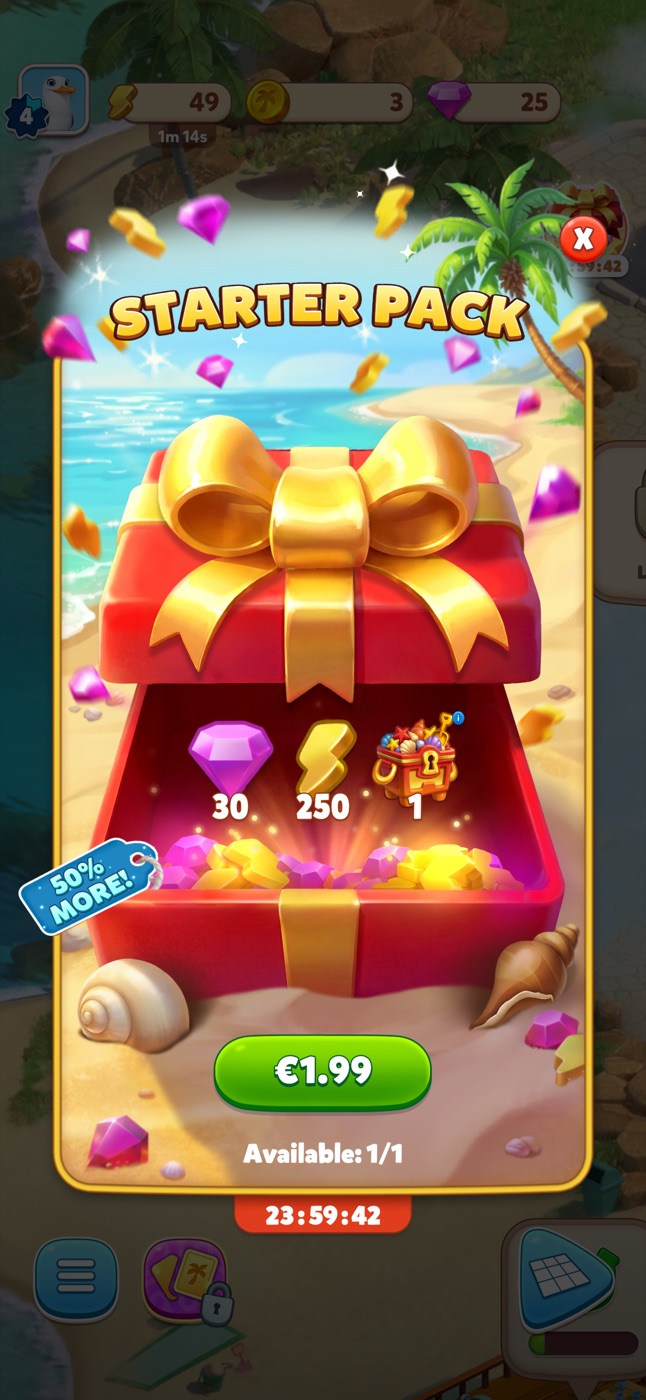
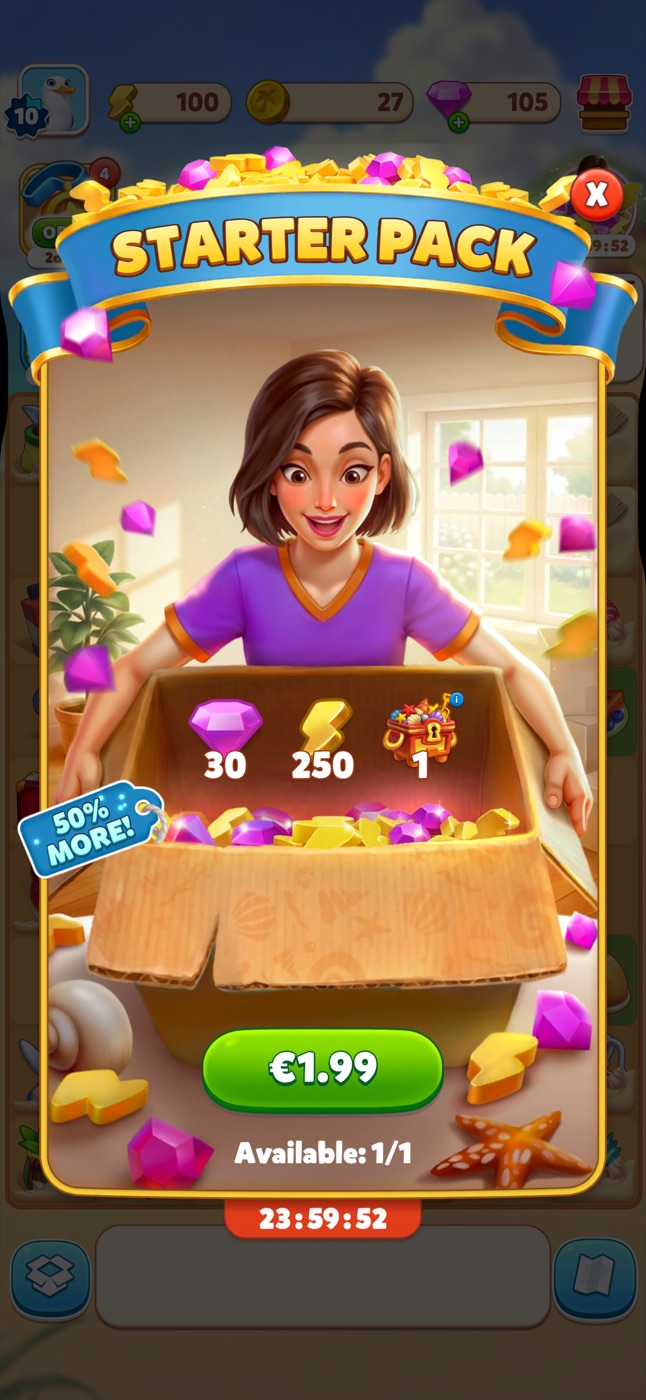
- The €1.99 Starter Pack says "50% MORE!". Counted at the shop's own prices, its gems and energy are worth 55 gems. The €1.99 gem pack gives 80, so the small chest of merge items would have to be worth 65 gems for the tag to be true.
- The starter shows up at level 4. The shop opens at level 6, so there's nothing to compare the "50% MORE" against.
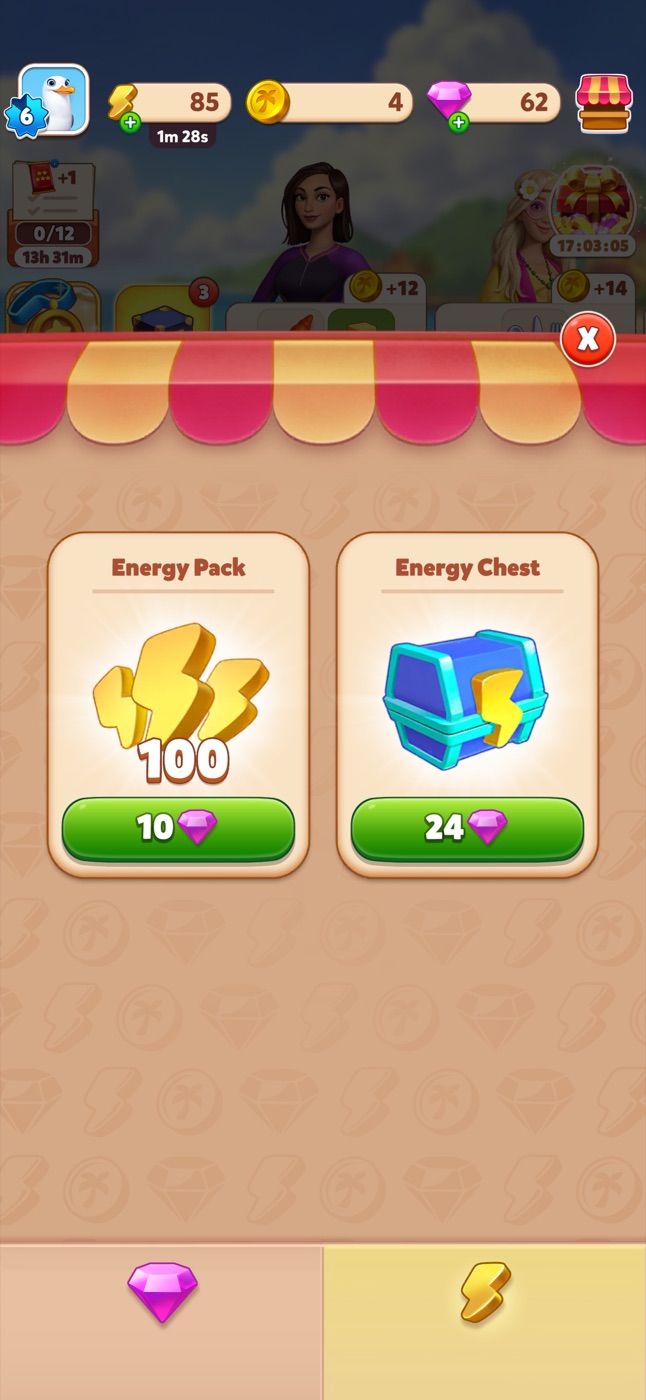
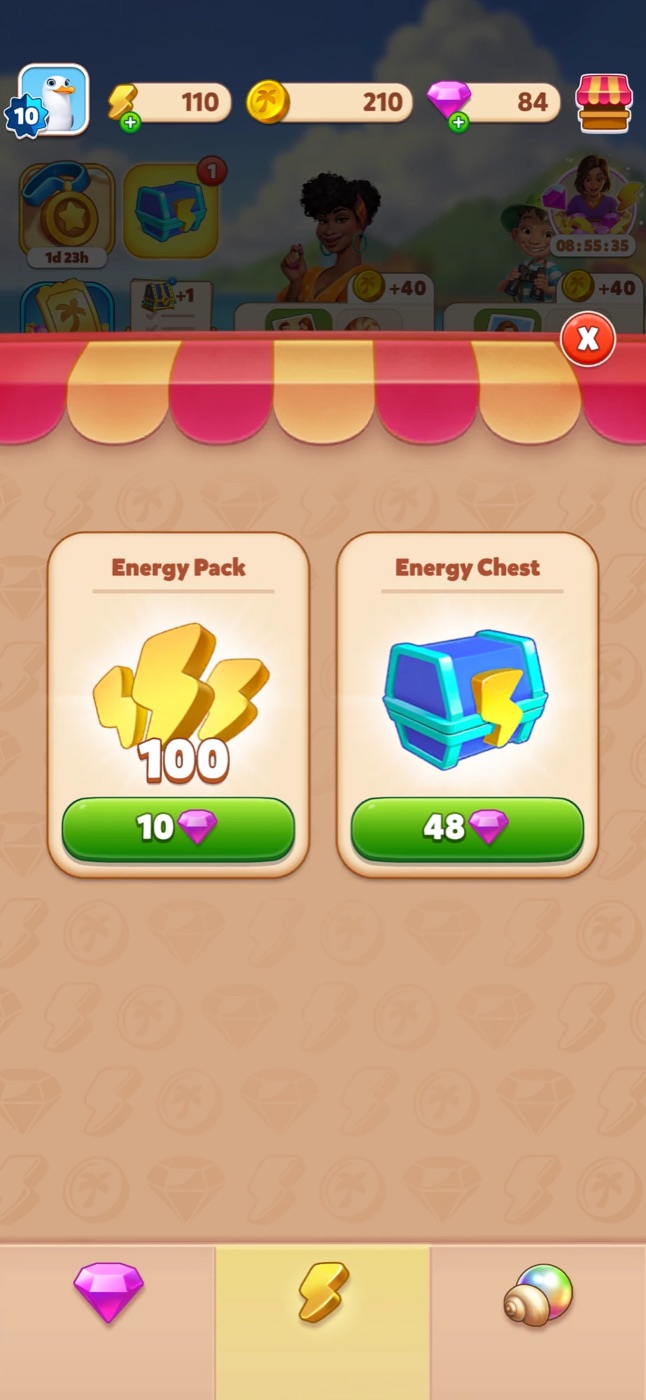
- Energy Chest: 24 gems gave me about 115 energy, next to 100 energy for 10 gems. After one purchase the chest costs 48.
- The gem ladder is flat from €1.99 to €5.99, jumps +45% at €9.99 (POPULAR), then barely moves until €99.99.
- For money, the shop sells only gems. Starter, Level Chase and Travel Pass live in popups and icons, never in the shop.
I played Travel Town (Magmatic Games, part of Moon Active since 2022) up to level 10, only to look at the shop and the offers around it. Every screen below is from an EU account, prices in euros.
Travel Town is one of the biggest merge games on mobile, so I expected a polished shop. The shop itself is pretty good. It's small, clear, and the €9.99 pack is exactly where it should be.
What surprised me was the stuff around it. The first thing the game ever tries to sell you, at level 4, is a starter pack with a "50% MORE!" tag. Two levels later the shop opens, and its cheapest gem pack turns out to be the better deal.
About the game and the shop
Travel Town is a merge-2 game. You merge items on a board, items fill orders from characters, orders give coins and experience, and you rebuild a seaside town. Every tap on a generator costs energy.
Three currencies:
- Energy (lightning): spent on generators, refills over time, about one point a minute or two.
- Coins (palm coins): soft currency from orders.
- Gems: the only currency you buy for money.
The shop isn't there from the start. It opens at level 6 with two tabs, gems and energy. A third tab with items for gems appears at level 10. Offers and the season pass never appear in the shop: they live in popups and in icons on the main screen.
I didn't see a single ad up to level 10, and there's no Remove Ads product. It looks like an IAP-only game.
1. What appears when
| Player level | What | Price |
|---|---|---|
| 4 | Starter Pack popup, 24-hour timer, "Available 1/1". No shop yet | €1.99 |
| 6 | The shop: gems and energy tabs | €1.99 to €99.99 |
| 7 | Level Chase, a 5-day event with a paid lane | €3.99 |
| 9 | Travel Pass with two paid versions | €5.99 / €8.99 |
| 10 | Third shop tab: items for gems, refreshes every 6 hours | gems only |
| 10 | Starter Pack again, same contents, new art, another 24 hours | €1.99 |
The order makes sense: a cheap first offer, then the shop, then an event, then the pass. Showing the starter a second time is good practice too. A player who skipped it at level 4 knows much more about the game at level 10.
2. Gem packs
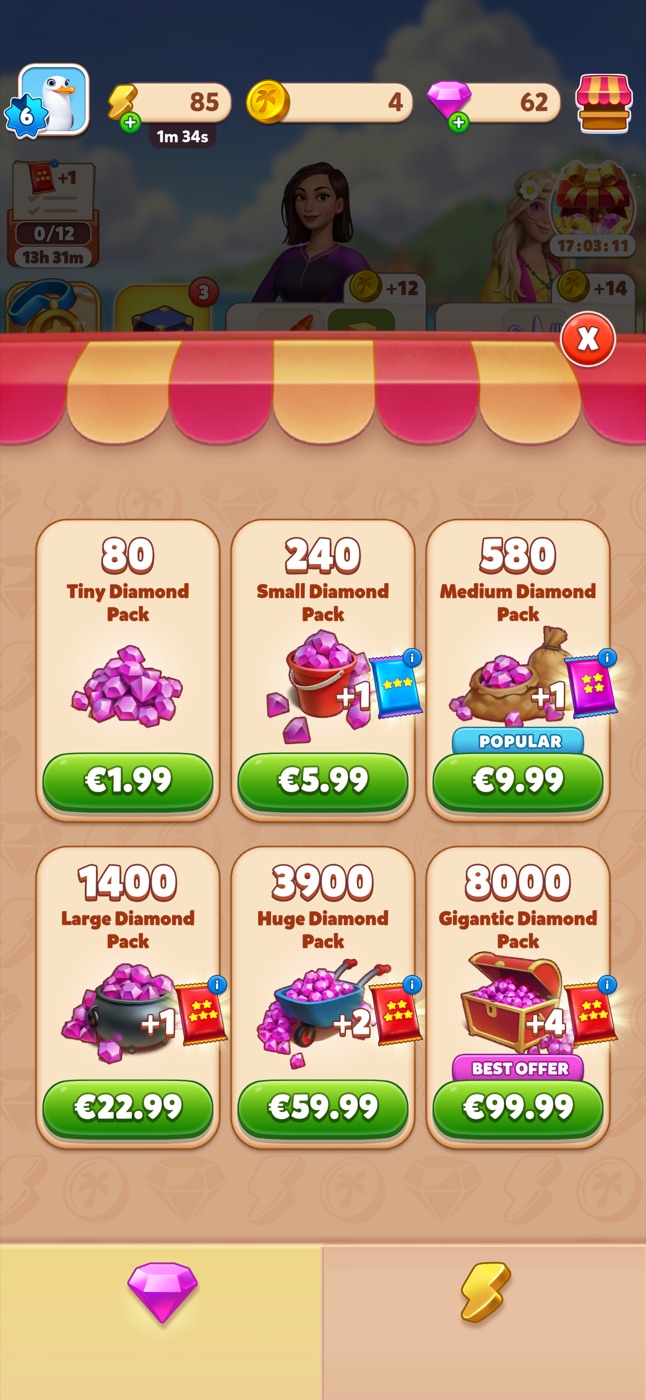
| Pack | Gems | Price | Gems per € | Value index | Extra |
|---|---|---|---|---|---|
| Tiny | 80 | €1.99 | 40.2 | 1.00 | |
| Small | 240 | €5.99 | 40.1 | 1.00 | 1 sticker pack |
| Medium (Popular) | 580 | €9.99 | 58.1 | 1.44 | 1 sticker pack |
| Large | 1,400 | €22.99 | 60.9 | 1.51 | 1 sticker pack |
| Huge | 3,900 | €59.99 | 65.0 | 1.62 | 2 sticker packs |
| Gigantic (Best Offer) | 8,000 | €99.99 | 80.0 | 1.99 | 4 sticker packs |
High €1.99 → €5.99 is a flat step (in fact −0.3% per euro). 240 gems is exactly three Tiny packs. The only thing Small adds is a sticker pack for the album. A player who wants gems has no reason to pick it.
The jump at €9.99 is right. +45% over the step before, on the pack with the POPULAR ribbon. This is how you make the €9.99 pack the obvious choice, and Travel Town does it cleanly.
Medium Then almost nothing until €99.99. Large gives 5% more per euro than Medium for 2.3 times the price. Huge adds another 7%. The ladder only gets generous again at the very top (+23%). €22.99 is also an unusual price point; €19.99 is the more common one for this step.
The sticker packs are a nice touch. Every pack from €5.99 up feeds the card album, and bigger packs give rarer stickers. It gives the mid packs a second reason to exist, which the gem count alone doesn't.
3. Energy: the pack and the chest
The energy tab has two products, both for gems. You can't buy energy for money directly.
| Product | Price | What you get | Energy per gem |
|---|---|---|---|
| Energy Pack | 10 gems | 100 energy | 10 |
| Energy Chest | 24 gems | a chest on the board; tap it and energy falls out, which you can merge into bigger pieces | about 4.8 |
| Energy Chest, second purchase | 48 gems | same chest | about 2.4 |
The chest has no info screen. You buy it, it lands on the board, you tap it and it spills energy pieces. Merge them and the total grows, so the result depends on how well you merge. My one chest gave about 115 energy in total. After that the price went up from 24 to 48 gems, and the Energy Pack next to it stayed at 10.
High The chest I opened lost to the pack by about half. At 24 gems it gave about 2 times less energy per gem than the Energy Pack. To match the pack it would need to produce 240 energy at 24 gems, and 480 at 48. With the same 115, the second chest would be about 4 times worse than the pack.
I can see why a merge game would want energy as a mergeable item: it's more fun to tap a chest than to see a number go up. But then the chest should be the better deal, or at least an equal one. Right now the fun option costs more, and the price doubles after you try it once.
Putting energy behind gems is right, though. It keeps gems the only "money" currency, and every energy purchase goes through the gem ladder.
4. Running out of energy
The first time you run out, the game simply gives you 100 energy. That's a good first touch: it shows what energy does without asking for anything.
The next time it sends you to the shop. The regular shop, with nothing made for this moment.
Medium No offer at the most important moment of a merge game. Out of energy is the moment a merge player is most willing to pay, and the game shows the full gem ladder starting at €1.99. If the starter pack is still available, this is where it should be.
5. Starter Pack
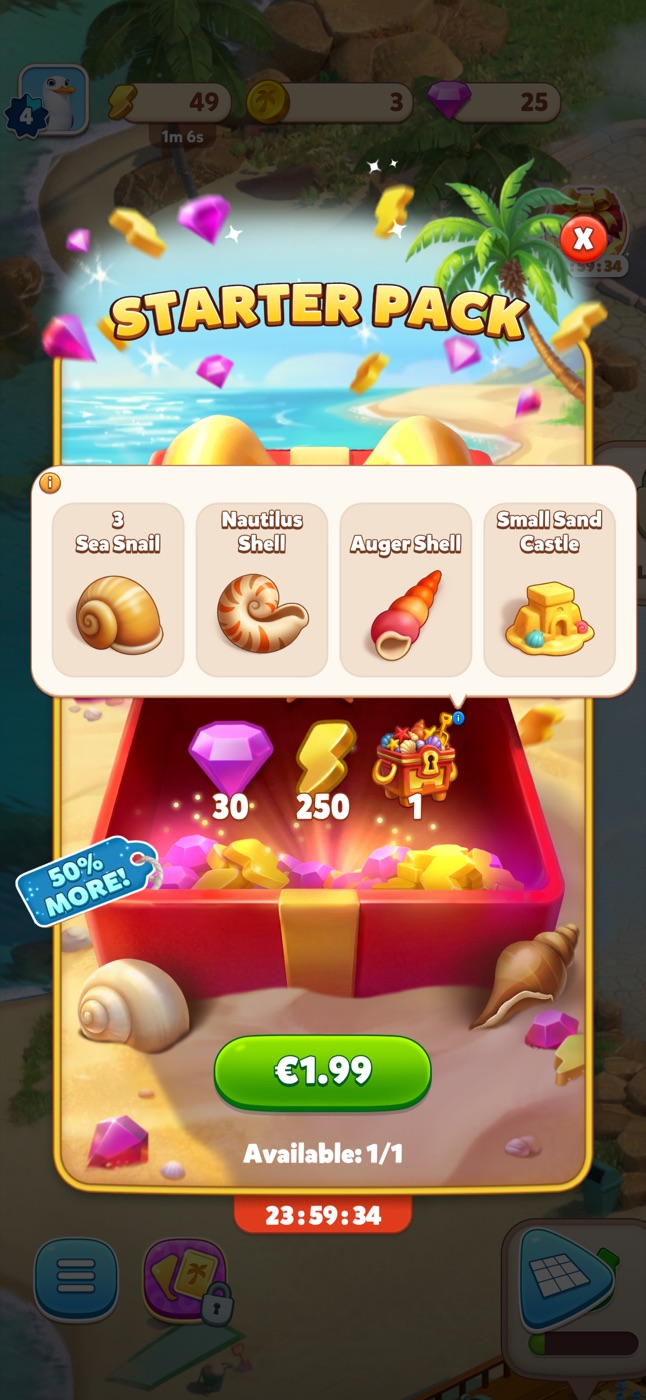
€1.99, one purchase, 24-hour timer: 30 gems, 250 energy and a chest of merge items (3 Sea Snails, a Nautilus Shell, an Auger Shell, a Small Sand Castle). A blue tag says "50% MORE!".
Count it at the shop's own prices. 250 energy is 25 gems at the Energy Pack price. So the gems and energy together are worth 55 gems.
| Starter Pack | Tiny gem pack | |
|---|---|---|
| Price | €1.99 | €1.99 |
| Gems | 30 | 80 |
| Energy | 250 (= 25 gems) | |
| Total in gems | 55 + chest | 80 |
| In energy, if spent on Energy Packs | 550 + chest | 800 |
Critical Without the chest, the "50% MORE!" pack is worth less than the plain €1.99 pack. The tag doesn't say what it's 50% more than, so I'm using the obvious base, the gem pack at the same price. Then the chest has to be worth 25 gems just to break even with Tiny, and about 65 gems for the tag to be true. It's six merge items. In the gem stall (the third tab) a different chest cost 70 gems and a sand castle 17. I can't price these exact items, but I'd be very surprised if they added up to 65 gems.
And the timing makes it worse. At level 4 there's no shop. The player can't compare the starter with anything, so "50% MORE" is just a feeling. Two levels later the shop opens, and a player who does the math sees that the first thing they bought was probably a worse deal than the cheapest gem pack.
Most players won't do the math. But the ones who do are often the ones who will spend the most later.
6. Level Chase
At level 7 a 5-day event starts: Level Chase. Each row is a number of level-ups during the event, with a free reward and a paid one. The paid lane costs €3.99.
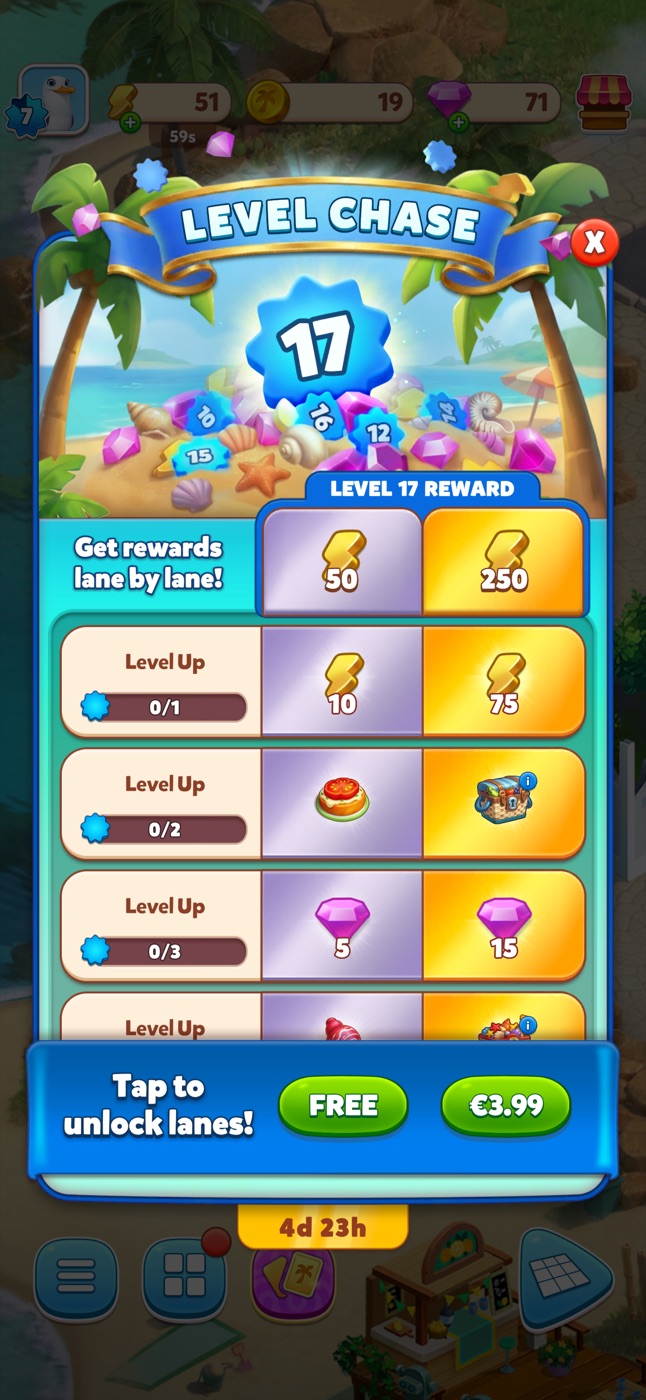
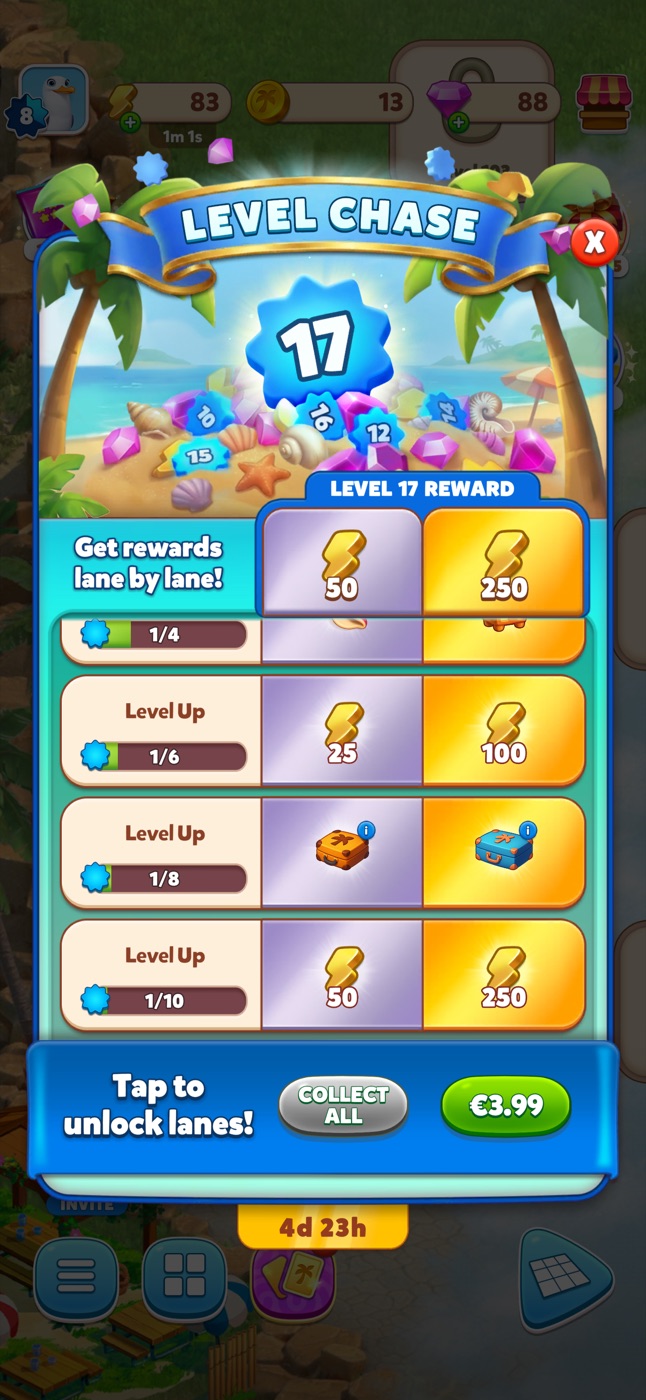
| Level-ups | Free | Paid |
|---|---|---|
| 1 | 10 energy | 75 energy |
| 2 | a food item | a picnic chest |
| 3 | 5 gems | 15 gems |
| 4 | a shell | a chest |
| 6 | 25 energy | 100 energy |
| 8 | orange suitcase | blue suitcase |
| 10 (level 17) | 50 energy | 250 energy |
The paid lane gives 425 energy, 15 gems and three containers. At the shop's prices that's 57.5 gems plus the containers. €3.99 buys about 160 gems in Tiny packs.
Medium The part of the paid lane I can count is about a third of its price. The containers have to carry the rest. They may well be worth it, but the player sees mostly energy, and energy is the cheapest thing in the shop.
The structure itself is good. It rewards something the player does anyway (leveling up), the free lane is real, and 10 level-ups in 5 days is a goal a new player can actually see.
7. Travel Pass
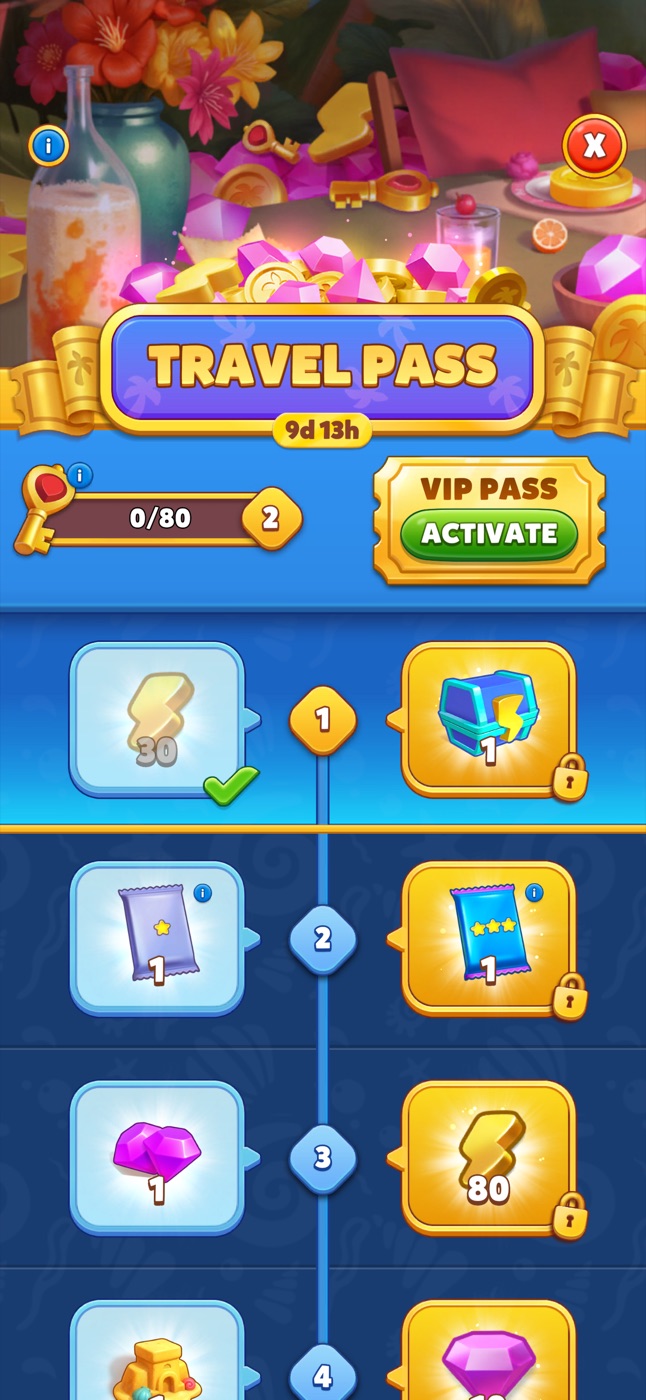
At level 9 the Travel Pass opens: a key track with 80 keys per step, about 9.5 days left when I saw it. Free and VIP rewards on every step.
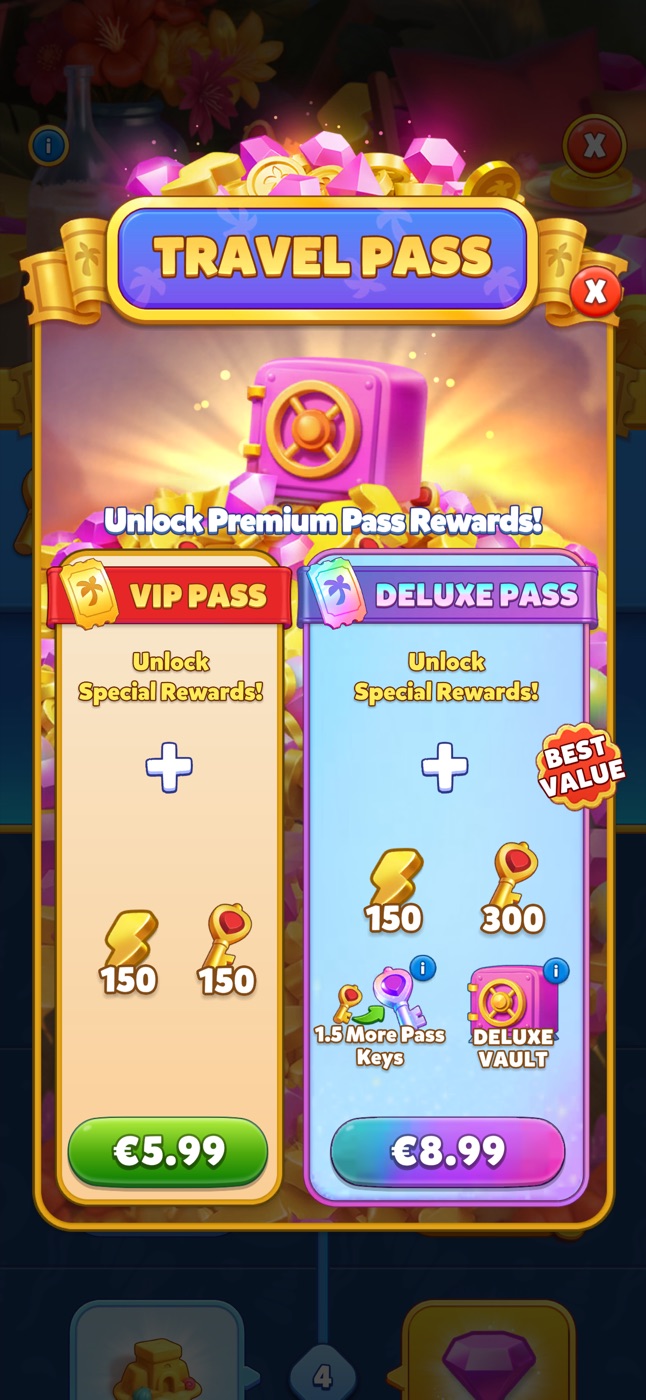
| Version | Price | Right away | On top |
|---|---|---|---|
| VIP | €5.99 | 150 energy, 150 keys | the VIP reward track |
| Deluxe (Best Value) | €8.99 | 150 energy, 300 keys | ×1.5 keys for the rest of the pass, Deluxe Vault, the VIP track |
VIP is the anchor and Deluxe is the target. For €3 more (+50%) you get twice the starting keys (300 instead of 150, about 3.75 steps instead of 1.9 if every step costs 80), every later key ×1.5, and a vault. This is a classic and it's well done. The duration is on the screen too.
A small detail I liked: the first VIP reward is the same Energy Chest the shop sells for 24 gems. So the pass hands out the shop's item as a reward, which makes it feel worth something.
I didn't see the whole track or what's inside the Deluxe Vault, so I can't put a number on the pass.
8. The gem stall (third tab)
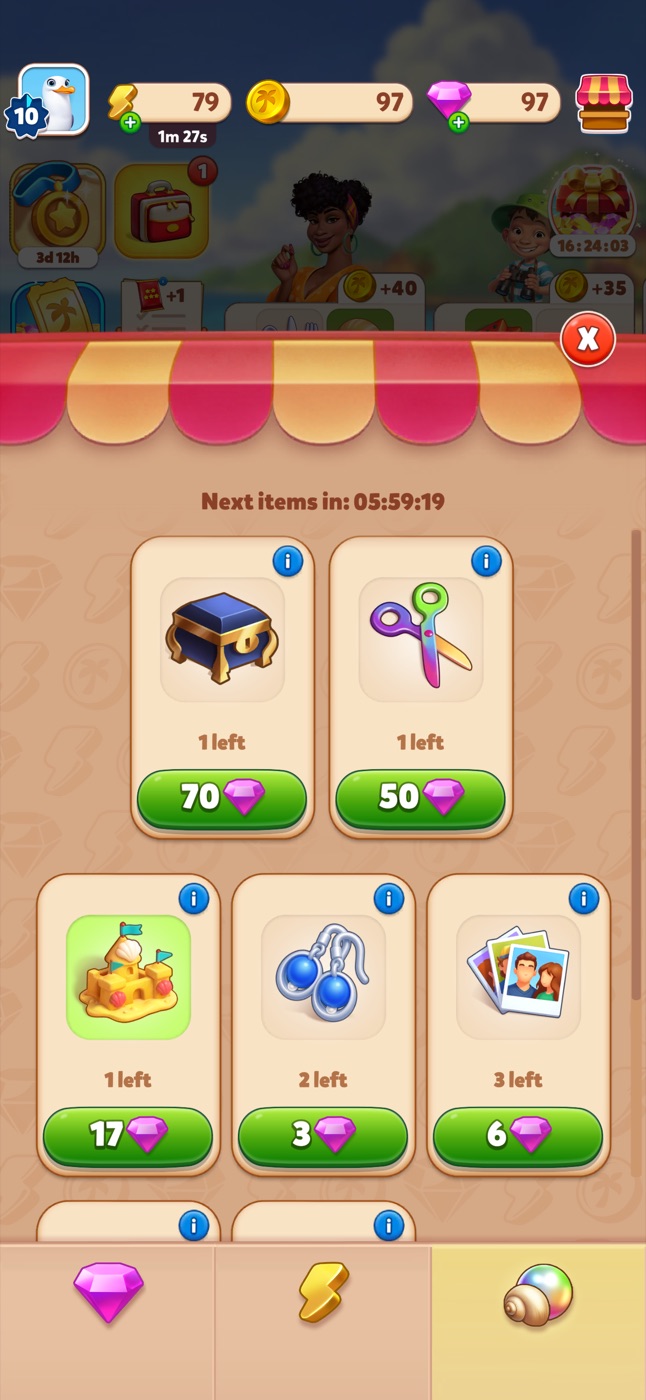
At level 10 a third tab opens: items for gems, a limited number of each, new items every 6 hours.
| Item | Price | Left |
|---|---|---|
| Chest | 70 gems | 1 |
| Scissors | 50 gems | 1 |
| Sand castle | 17 gems | 1 |
| Earrings | 3 gems | 2 |
| Photos | 6 gems | 3 |
| Cutlery | 3 gems | 4 |
| Stones | 1 gem | 4 |
This is a gem sink and a shortcut for orders: buy the item you need instead of merging up to it. Cheap items at 1 to 6 gems give a player with a few spare gems something to do. The 6-hour refresh is a reason to come back to the shop, which the first two tabs don't have.
9. UX and overall design
What's done well:
- The shop is simple: gems, energy, items. Nothing to get lost in.
- The €9.99 pack gets the big jump (+45%) and the POPULAR ribbon.
- Gems are the only paid currency, energy goes through gems.
- The starter is shown twice, at level 4 and level 10.
- The first out-of-energy moment is a gift of 100 energy, not a sale.
- Travel Pass: VIP and Deluxe are a good pair, and the duration is visible.
- Sticker packs give mid gem packs a second reason to exist.
- No ads, so the out-of-energy moment belongs to the shop.
Problems:
| Severity | Problem | Where |
|---|---|---|
| Critical | "50% MORE!" starter: gems and energy worth 55 gems by the shop's prices, the €1.99 pack is 80 | Starter Pack |
| High | Energy Chest: about 2 times less energy per gem than the pack in my test, and the price doubles after one purchase | energy tab |
| High | €1.99 → €5.99 is flat on gems | gem packs |
| Medium | €9.99 → €59.99: +5% and +7% | gem packs |
| Medium | No offer when energy runs out (after the first time) | out of energy |
| Medium | Level Chase paid lane: the countable part is a third of the price | Level Chase |
| Low | A closed starter can only be found through a timer icon, never in the shop | offers |
10. Recommendations
1. Make the starter beat the €1.99 pack on gems alone. 95 gems instead of 30, with the same 250 energy, is 120 gems' worth, exactly +50% over Tiny before the chest. Then "50% MORE" is true, and the chest is a real bonus on top. If the content can't change, change the tag: a starter doesn't need a number on it to sell.
2. Fix the Energy Chest. Either a normal merge gets at least 240 energy out of a 24-gem chest, so a good merge beats the pack, or, if it stays at about 115 energy, it costs 11 gems. Don't double the price after the first purchase. And show the range the chest is tuned to on the card, so the player knows what they're buying.
3. Put a bonus on the €5.99 pack. 280 gems instead of 240 is +16% over Tiny, so the step stops being flat.
4. Lift the middle of the ladder. Large 1,400 → 1,600 gems and Huge 3,900 → 4,400. The ladder becomes 1.00 / 1.16 / 1.44 / 1.73 / 1.82 / 1.99, and every step is better than the last.
5. Use the out-of-energy moment. From the second time on, show the Starter Pack if it's still unclaimed, or a small energy offer at €0.99 to €1.99, before the full shop.
6. Add gems to the Level Chase paid lane. 50 gems instead of 15 on step 3 brings the countable part to about 90 gems, more than half the price, with the containers on top.
11. Conclusion
Travel Town's shop is small and mostly right: one paid currency, a clear €9.99 target, a good VIP/Deluxe pair on the pass, a gem stall that brings players back. The weak spots are the first two things a new player meets. A starter pack whose "50% MORE!" doesn't survive the shop's own prices, and an energy chest that gave half the energy per gem of the pack right next to it.
If they fix only one thing, it should be the starter. It's the first purchase in the game, and it should be the best deal in it, not one that loses to the cheapest gem pack.
Get new teardowns by email
One email when a new shop teardown is out, usually twice a month. The numbers, what works, what I'd change. Unsubscribe in one click.
Game Shops: Ultimate Guidelines
Second edition, rewritten for 2026: the Value Ladder method, web shops, a one-hour shop audit and 13 case files. Everything behind the teardowns on this site.
Get the bookSample shop report
A real Game Shop Snapshot: the top 5 issues in a live game's shop, the numbers behind each one and the order to fix them in.
Download the sample
Michael Khripin has spent 25+ years in online games: LiveOps, monetization and production, including Wargaming R&D and LiveOps on Hero Wars Mobile at Nexters. Author of Game Shops: Ultimate Guidelines. Runs New Perk, a game shop and LiveOps consultancy.