Key findings
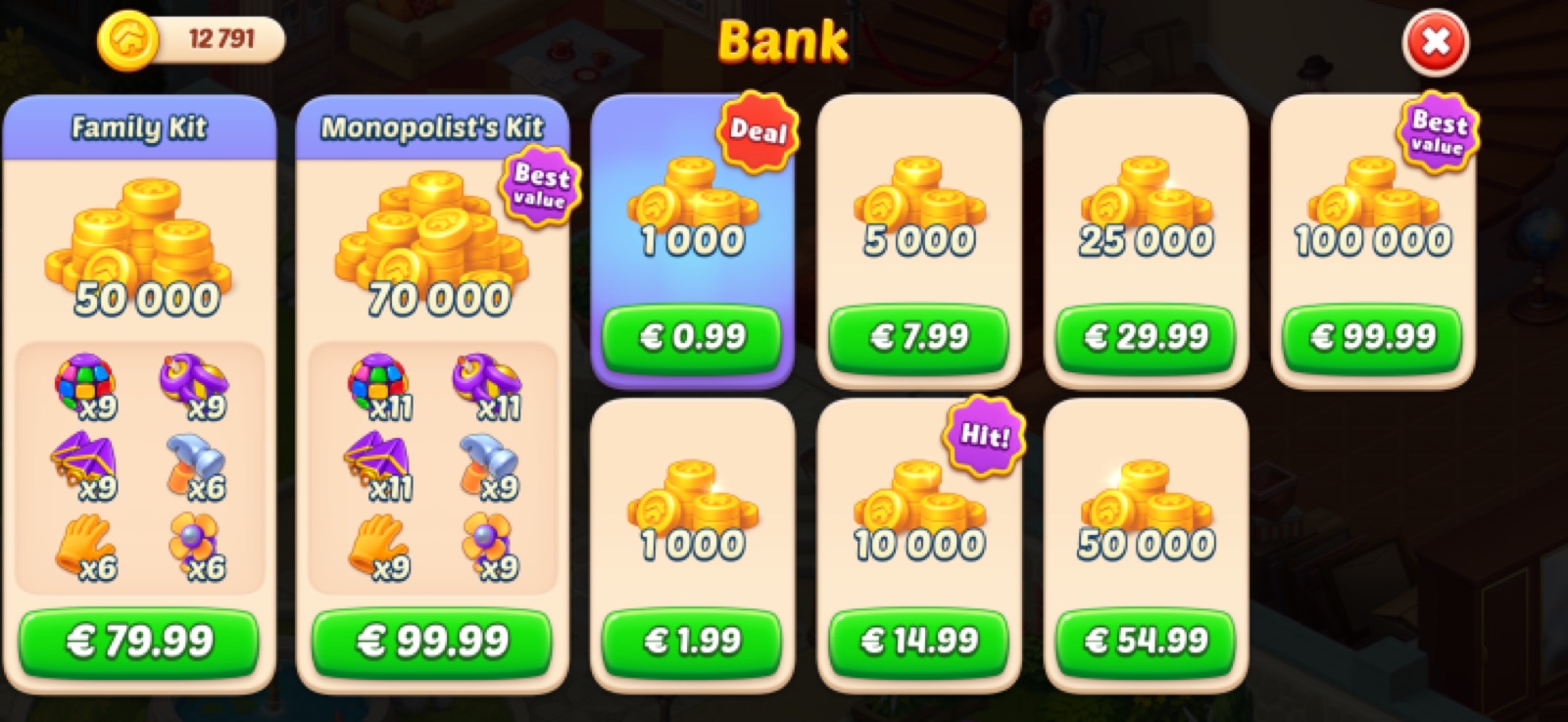
- The coin pack ladder is clean: value rises monotonically from 502.5 to 1,000.1 coins/€, a genuine 2× bonus on the €99.99 pack.
- The €0.99 intro offer has no One Time Only marker, although it disappears permanently after purchase.
- Starter Kit (€4.99) is the weakest mini-shop offer: 400.8 coins/€ vs 754.0 for the €1.99 Welcome Pack and 836.1 for the €2.99 Special Offer.
- Kits scale 1:1 from Butler's to Family, and the cost per booster rises from ~€0.40 to ~€0.56. Only Monopolist's (€99.99) adds a content premium.
- Dead zone between Pack 2 and Pack 3: only +6.6% more coins/€ for nearly double the price, yet Pack 3 carries a "Hit!" badge.
About the Game and Analysis Context
Homescapes is a mid-core match-3 puzzle game by Playrix — one of the most successful and profitable mobile titles globally. The shop, confusingly named the "Bank" (more on this below), reflects the scale and ambition of the product: it's a significantly more layered operation than what you'd find in a typical hybrid-casual game.
The shop operates in two distinct modes:
- Mini-shop — A compact horizontal carousel of 4–5 contextual offers, shown as a popup — likely triggered by resource scarcity or session entry. This is the player's first contact with the shop.
- Full shop — A scrollable interface opened via "More Offers!" from the mini-shop, containing the complete catalog: currency packs and bundle Kits.
This mini/full split is one of three core layout patterns (→ Game Shops: Ultimate Guidelines, ch. 1.2 Layout). Playrix uses the split effectively: the mini-shop pre-filters by urgency and relevance, while the full shop serves deliberate buyers who want to see everything.
A Note on Naming: Why "Bank"?
Calling the in-game shop "Bank" is an unusual choice. In most F2P games, the shop is called Store, Shop, Market, or a thematic equivalent (Tavern, Treasury, etc.). "Bank" implies a place where you deposit and store value — not where you spend it. For a player, the mental model of a bank is "my money is safe here," not "this is where I buy things."
This naming likely works against conversion at the margin. Players who feel financially cautious may subconsciously associate "Bank" with savings and restraint rather than spending and value exchange. A thematic name tied to the game's home-renovation narrative — "Shop," "Catalog," or even "Market" — would be more purchase-oriented.
1. Shop Structure
1.1 Mini-Shop Layout (Contextual Carousel)
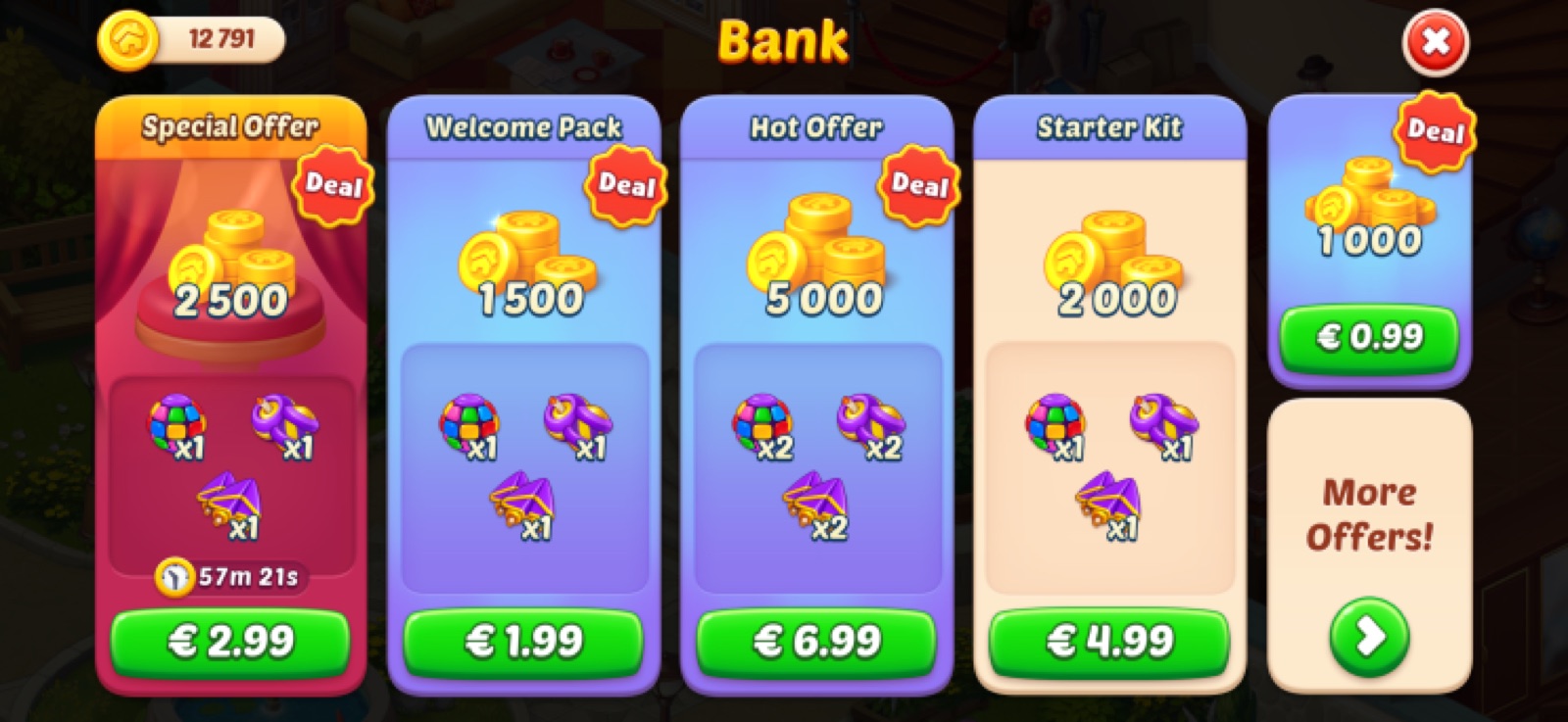
The mini-shop is not a fixed template — its composition changes based on what Playrix wants to surface. Two distinct mini-shop states are visible across screenshots:
State A (base):
| Position | Offer | Price |
|---|---|---|
| 1 | Special Offer (timer 60 min) | €2.99 |
| 2 | Welcome Pack | €1.99 |
| 3 | Hot Offer | €1.99 |
| 4 | Starter Kit | €4.99 |
| 5 | → More Offers! | — |
State B (with seasonal content):
| Position | Offer | Price |
|---|---|---|
| 1 | Home Pass (Season Pass) | €9.99 |
| 2 | Weekend Deal | — (opens popup) |
| 3 | Hot Offer | €1.99 |
| 4 | Starter Kit | €4.99 |
| 5 | → More Offers! (+ coin pack €0.99) | — |
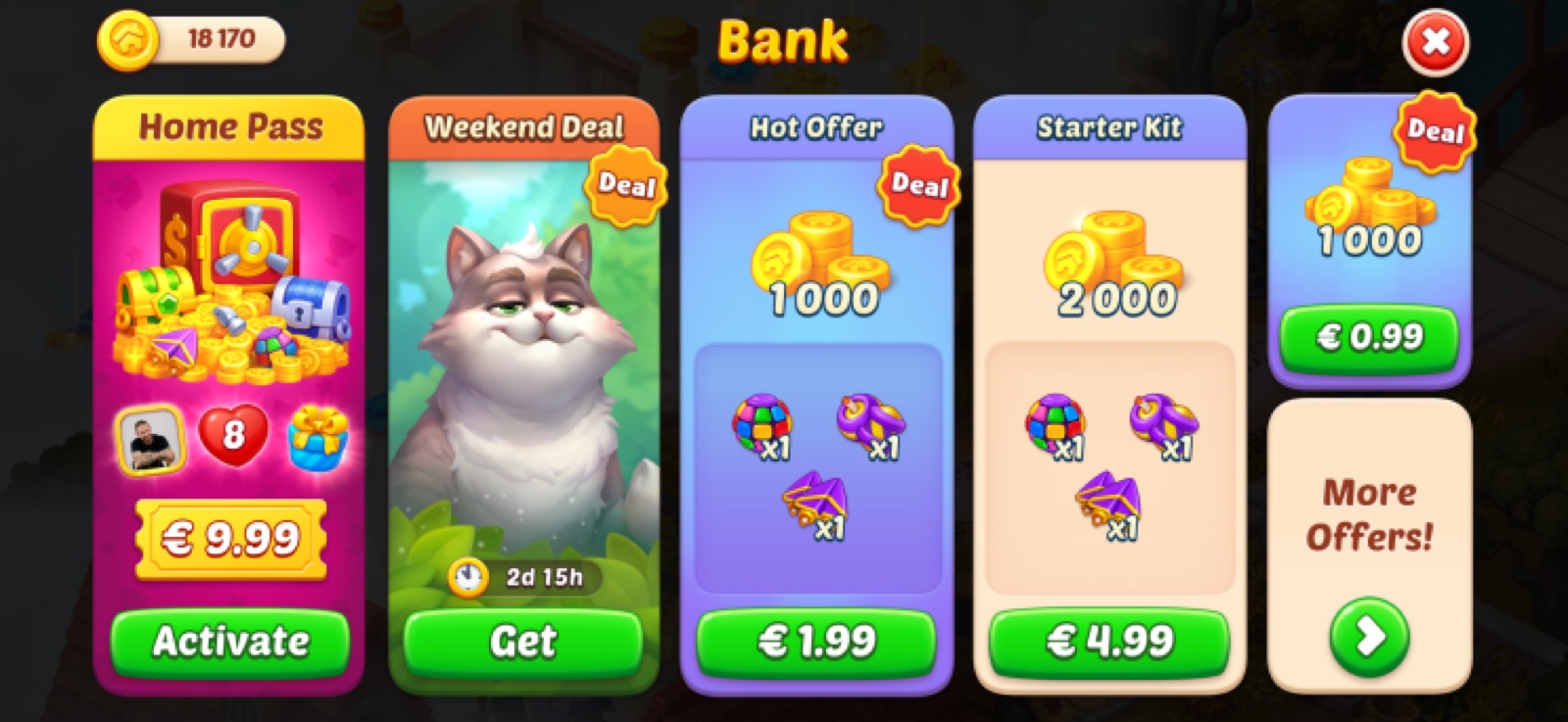
Assessment: Playrix injects time-limited and seasonal content directly into the mini-shop's leftmost positions — the highest-visibility slots. Home Pass takes position 1, displacing the Special Offer. Weekend Deal takes position 2, displacing the Welcome Pack. This is smart slot management: premium seasonal offers get the anchor position while evergreen offers (Hot Offer, Starter Kit) remain stable in positions 3–4.
The "More Offers!" gate serves as a deliberate intent filter: players who tap through are higher-commitment buyers. The €0.99 coin pack visible in the final slot of State B suggests the mini-shop also surfaces the intro offer as a quick-access shortcut.
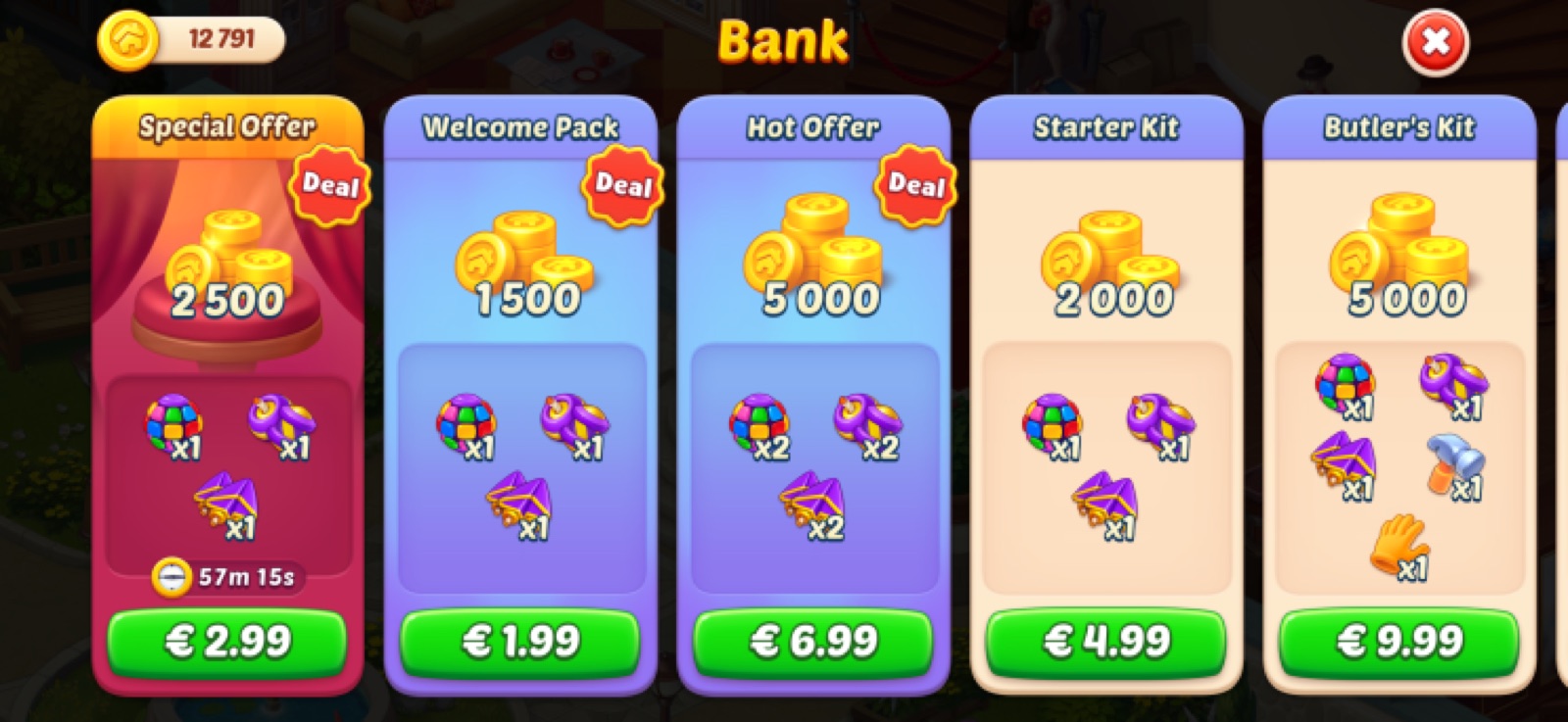
1.2 Full Shop Layout
| # | Section | Notes |
|---|---|---|
| 1 | Kits (Bundles) | 5 tiers: Butler's through Monopolist's |
| 2 | Currency Packs (7 items) | Two-column grid, ascending price order |
The full shop leads with Kits, then transitions to currency packs — following the "emotional → utilitarian" principle (→ Game Shops: Ultimate Guidelines, ch. 1.3 Sections).
1.3 What's Missing
- Free Daily Gift — No free reward section in either mini or full shop. Without it, there's no organic reason to open the shop daily. The "free visit → impulse purchase" funnel is inactive (→ Game Shops: Ultimate Guidelines, ch. 1.3 Sections).
2. Currency Packs
2.1 Data
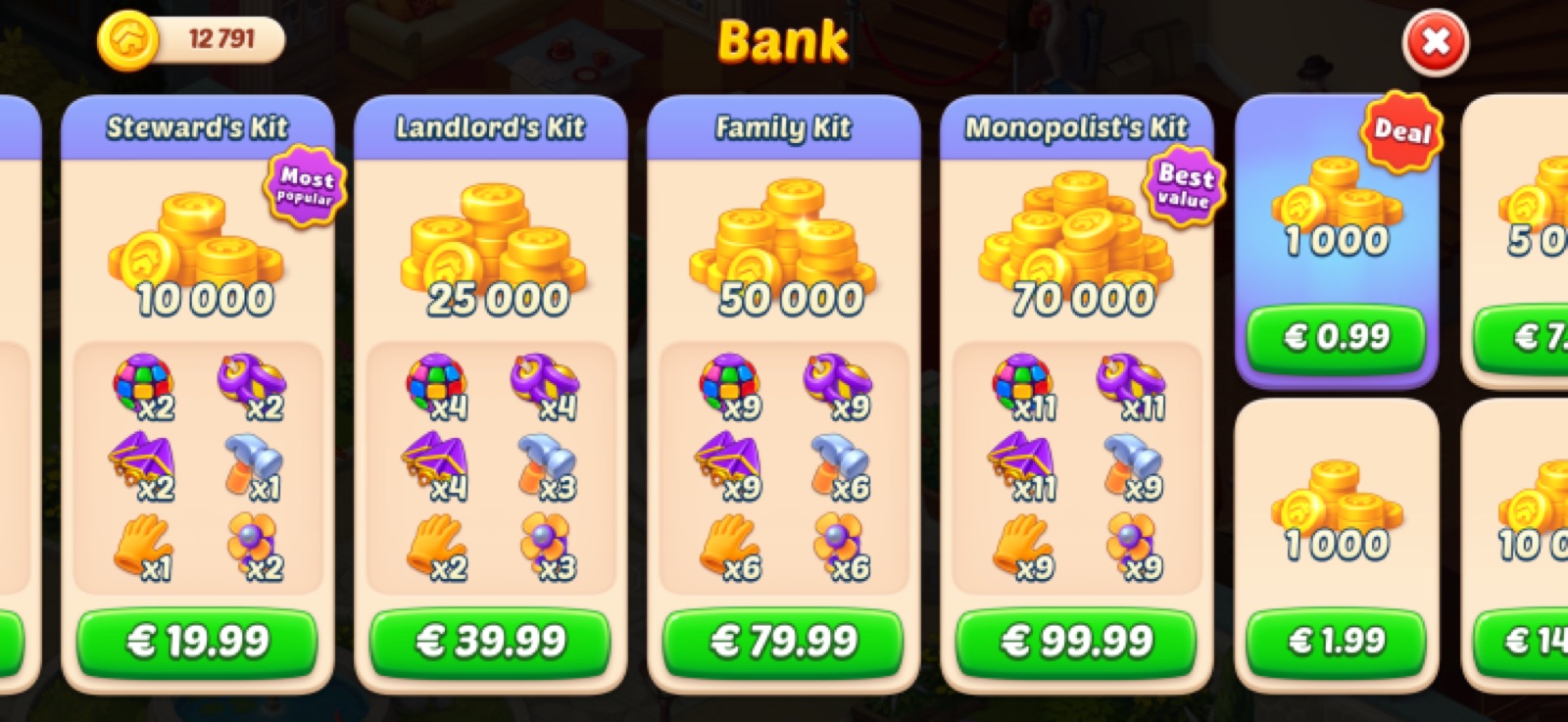
The full shop contains 7 coin packs in a two-column grid, read top-to-bottom then left-to-right in ascending price order. The first pack (€0.99) is a confirmed one-time introductory offer — it disappears permanently after purchase. It is visually distinct with a blue highlighted background and "Deal" badge, and priced at approximately half the "real" minimum. Critically, there is no "One Time Only" marker on this card. Analysis below treats €1.99 as the permanent base pack.
| Pack | Coins | Price (€) | Coins/€ | Value Index (base = 1.00) |
|---|---|---|---|---|
| Intro offer | 1,000 | 0.99 | 1,010.1 | — (one-time, separate) |
| Pack 1 | 1,000 | 1.99 | 502.5 | 1.00 (base) |
| Pack 2 | 5,000 | 7.99 | 625.8 | 1.25 |
| Pack 3 | 10,000 | 14.99 | 667.1 | 1.33 |
| Pack 4 | 25,000 | 29.99 | 833.6 | 1.66 |
| Pack 5 | 50,000 | 54.99 | 909.3 | 1.81 |
| Pack 6 | 100,000 | 99.99 | 1,000.1 | 1.99 |
2.2 Bonus Progression
Assessment: The Core Ladder Is Clean
The permanent currency pack progression is monotonically increasing — every subsequent pack delivers better coins/€ than the previous one. No pricing paradox, no buy-small arbitrage. This is solid pricing hygiene that many developers get wrong (→ Game Shops: Ultimate Guidelines, ch. 10: Pricing Psychology & Anchoring).
The top pack delivers a genuine 2× bonus over base — hitting the industry benchmark of 100%+ for the largest SKU (→ Game Shops: Ultimate Guidelines, ch. 11: Currencies & Economy Fit).
2.3 Minor Issue: Dead Zone Between Pack 2 and Pack 3
The step from Pack 2 (€7.99, 625.8 coins/€) to Pack 3 (€14.99, 667.1 coins/€) is only +6.6% — the smallest incremental jump in the ladder. For nearly double the price, the value improvement is barely perceptible.
| Comparison | Coins | Cost | Coins/€ |
|---|---|---|---|
| Pack 3 | 10,000 | €14.99 | 667.1 |
| 2× Pack 2 | 10,000 | €15.98 | 625.8 |
No arbitrage — Pack 3 is technically €0.99 cheaper for the same coins — but the value incentive to step up is weak. A "Hit!" badge on this pack (which it carries) doesn't help: a player comparing Pack 2 and Pack 3 will find the label doesn't match the math.
2.4 Critical UX Problem: Intro Offer Has No One-Time Marker
The €0.99 pack is a confirmed first-purchase conversion offer — verified: it disappears permanently after purchase. The "Deal" badge and highlighted blue background are the only signals the player gets. There is no "One Time Only" label, no timer, no explicit signal that this offer will not return.
This creates two concrete problems:
- Conversion loss: Without a scarcity signal, players feel no urgency to buy now. Many scroll past assuming it will always be there — and miss the window entirely.
- Trust damage: Players who buy it and later return expecting the same offer find it gone — with no prior warning. The surprise feels like a trick, not a feature.
- Benchmark gap: Every comparable intro offer in the market carries an explicit one-time marker. Homescapes's execution is below industry standard here (→ Game Shops: Ultimate Guidelines, ch. 7: Pop-up Shops).
2.5 Post-Purchase Behaviour: Sort Order Inversion
After the intro offer is purchased, the full shop re-sorts automatically — bundles and currency packs rearrange from most expensive to least expensive. This is a deliberate and well-reasoned design decision.
The logic: a player who has just made their first purchase has self-identified as a spender. Showing the highest-value offers first maximises the chance of a second, larger purchase in the same session. The default ascending order serves a pre-purchase player evaluating entry points; the inverted descending order serves a post-purchase player who has already crossed the spending threshold.
This is exactly the kind of contextual shop adaptation described in best practices: the shop responds to player state, not just player identity (→ Game Shops: Ultimate Guidelines, ch. 1.2 Layout). It is one of the more sophisticated monetization details visible in Homescapes's Bank — and easy to miss because it only appears after a purchase.
3. Special Offers (Mini-Shop Evergreen Offers)
3.1 Overview
Booster names per official Playrix documentation: Rainbow Ball (pre-level), Bomb and Rocket (pre-level), Double Planes (pre-level), Hammer (in-level), Glove (in-level), Broom (in-level), Kettlebell (in-level), Fan (in-level).
Based on icon shapes visible in screenshots, the three boosters present in mini-shop offers are Rainbow Ball, Hammer, and Glove — the three most commonly bundled boosters in Homescapes's kit lineup.
| Offer | Coins | Boosters | Price (€) | Coins/€ | Badge |
|---|---|---|---|---|---|
| Welcome Pack | 1,500 | Rainbow Ball ×1, Hammer ×1, Glove ×1 | 1.99 | 754.0 | Deal |
| Special Offer | 2,500 | Rainbow Ball ×1, Hammer ×1, Glove ×1 | 2.99 | 836.1 | Deal + Timer |
| Starter Kit | 2,000 | Rainbow Ball ×1, Hammer ×1, Glove ×1 | 4.99 | 400.8 | — |
| Hot Offer | 1,000 | Rainbow Ball ×1, Hammer ×1, Glove ×1 | 1.99 | 502.5 | Deal |
Note: Hot Offer appears at €1.99 / 1,000 coins in State B (with Home Pass active). In State A it may have different contents — the €6.99 / 5,000 coins version visible in earlier screenshots. Contents should be verified across multiple sessions.
3.2 Special Offer (€2.99) — Timer Done Right
The 60-minute timer is unusually short — most special offers use 24h timers. The offer reappears periodically (likely daily), but each appearance lasts only 60 minutes. This creates a tighter urgency window than standard offers: the player cannot simply return later in the day — they either act within the hour or miss it until the next cycle.
Crucially, the Special Offer's coins/€ ratio (836.1) is the best among the evergreen mini-shop offers — the most time-pressured offer is also genuinely the best value. This alignment is correct practice: urgency mechanics must back real value, not just marketing framing (→ Game Shops: Ultimate Guidelines, ch. 7: Pop-up Shops).
3.3 Starter Kit (€4.99) — The Weakest Offer in the Mini-Shop
| Offer | Coins | Boosters | Price | Coins/€ |
|---|---|---|---|---|
| Starter Kit | 2,000 | ×3 (1 each) | €4.99 | 400.8 |
| Welcome Pack | 1,500 | ×3 (1 each) | €1.99 | 754.0 |
| Special Offer | 2,500 | ×3 (1 each) | €2.99 | 836.1 |
The Starter Kit at €4.99 offers the worst coins/€ ratio in the mini-shop — substantially below both €1.99 options. A player spending 2.5× more than Welcome Pack gets 33% more coins and identical booster types.
No "Deal" badge. No timer. No "One Time Only." No hidden perks. The Starter Kit has no clear value proposition relative to the flanking offers — this is a structural problem, not a display limitation. It occupies a premium price slot without delivering a compelling reason to choose it over cheaper alternatives (→ Game Shops: Ultimate Guidelines, ch. 2.2: "A good starter pack feels unfairly generous").
4. Kits (Bundles)
4.1 Kit Contents
Homescapes boosters include: Rainbow Ball (pre-level), Bomb and Rocket (pre-level), Double Planes (pre-level), Hammer, and Glove (in-level). Based on icon analysis of the screenshots, Kits contain a combination of pre-level boosters (Rainbow Ball, Bomb+Rocket) and in-level boosters (Hammer, Glove, plus two additional types visible as a purple rocket/plane icon and an orange hand).
Each Kit follows a two-tier booster distribution:
- Full set (×N): Rainbow Ball, Bomb+Rocket, one additional — always in equal, higher quantities
- Partial set (×0.67N–0.75N): Hammer, Glove, Fan — consistently fewer
| Kit | Price (€) | Coins | Full-set boosters | Partial-set boosters | Total |
|---|---|---|---|---|---|
| Butler's | 9.99 | 5,000 | ×1 / ×1 / ×1 | ×1 / ×1 | 5 |
| Steward's | 19.99 | 10,000 | ×2 / ×2 / ×2 | ×1 / ×1 / ×2* | 10 |
| Landlord's | 39.99 | 25,000 | ×4 / ×4 / ×4 | ×3 / ×2 / ×3 | 20 |
| Family | 79.99 | 50,000 | ×9 / ×9 / ×9 | ×6 / ×6 / ×6 | 45 |
| Monopolist's | 99.99 | 70,000 | ×11 / ×11 / ×11 | ×9 / ×9 / ×9 | 60 |
4.2 Scaling Between Tiers
| Transition | Price × | Coin × | Booster × |
|---|---|---|---|
| Butler's → Steward's | ×2.00 | ×2.00 | ×2.00 |
| Steward's → Landlord's | ×2.00 | ×2.50 | ×2.00 |
| Landlord's → Family | ×2.00 | ×2.00 | ×2.25 |
| Family → Monopolist's | ×1.25 | ×1.40 | ×1.33 |
Assessment — Butler's through Family: Scaling is essentially 1:1 — content grows at the same rate as price. The player gets proportional value at each tier, but no increasing reward for spending more. This neutralizes the incentive to upgrade: there's no "buy Landlord's instead of two Steward's because it's a better deal" signal (→ Game Shops: Ultimate Guidelines, ch. 2.2: Bundle Design Patterns).
Assessment — Family → Monopolist's: The top tier breaks the 1:1 pattern correctly — content grows faster than price (×1.40 coins, ×1.33 boosters vs. ×1.25 price). The "Best value" badge is mathematically earned. But this premium only emerges at the €99.99 tier, leaving the four lower tiers feeling interchangeable.
4.3 Booster Design Pattern — Two Weight Classes
The full-set vs. partial-set split is consistent across all five Kit tiers. The ratio holds regardless of tier, indicating a deliberate structural decision: partial-set boosters (likely Hammer, Glove — the in-level "surgical" tools that directly influence specific tiles) are rationed more carefully than pre-level boosters that place a random power-up on the board. This is thoughtful internal bundle balancing (→ Game Shops: Ultimate Guidelines, ch. 11: Currencies & Economy Fit).
4.4 Coin vs. Booster Value Split
Using the nearest currency pack price as coin value reference:
| Kit | Price | Coin Value (ref. pack) | Remainder for Boosters | Total Boosters | ~€/Booster |
|---|---|---|---|---|---|
| Butler's | €9.99 | ~€7.99 (5K coins) | ~€2.00 | 5 | ~€0.40 |
| Steward's | €19.99 | ~€14.99 (10K coins) | ~€5.00 | 10 | ~€0.50 |
| Landlord's | €39.99 | ~€29.99 (25K coins) | ~€10.00 | 20 | ~€0.50 |
| Family | €79.99 | ~€54.99 (50K coins) | ~€25.00 | 45 | ~€0.56 |
| Monopolist's | €99.99 | ~€75 (est.) | ~€25 (est.) | 60 | ~€0.42 (est.) |
Notable pattern: Cost per booster is flat or slightly rising from Butler's to Family (€0.40 → €0.50 → €0.50 → €0.56). A player buying more expensive kits pays more per booster, not less — until Monopolist's at €99.99. This undercuts the value argument for upgrading from mid-tier to Family Kit.
5. Home Pass (Season Pass) — €9.99
The Home Pass is Homescapes's equivalent of a season pass or battle pass. It occupies the anchor position (slot 1) in the mini-shop when active, displacing the evergreen Special Offer. It is presented in a visually distinct card with a pink/magenta background — more vibrant than any other card in the carousel.
Contents visible from screenshot:
- A themed safe/chest with resources
- 8 lives (heart icon with ×8)
- A gift box (additional reward)
- A user avatar slot (social feature?)
- Price: €9.99, with "Activate" CTA instead of "Buy"
Assessment:
The "Activate" button language is deliberately chosen — it frames the purchase as unlocking an experience, not spending money. This is psychologically sound: spending feels like a loss, activation feels like enabling a reward. Well executed (→ Game Shops: Ultimate Guidelines, ch. 13: Payment UX & Friction Removal).
The anchor slot positioning is correct for a season pass: it's the highest-revenue potential offer and deserves maximum visibility.
On duration: Homescapes surfaces a dedicated promotional popup for the season launch before the Bank is opened, and the season end date is stated there. This means the card face doesn't need to repeat the duration — the player already has context. This is a reasonable UX decision: show duration once at the point of introduction, not on every card view. €9.99 is a reasonable price point for a mobile season pass — well within the market range of $4.99–$14.99/month for this category.
6. Weekend Deal — Popup with Two Bundle Options
The Weekend Deal occupies position 2 in the mini-shop when active. Unlike every other offer in the Bank, it does not display a price on the card — the CTA says "Get" and the offer opens a full-screen popup revealing two bundle options at different price points.
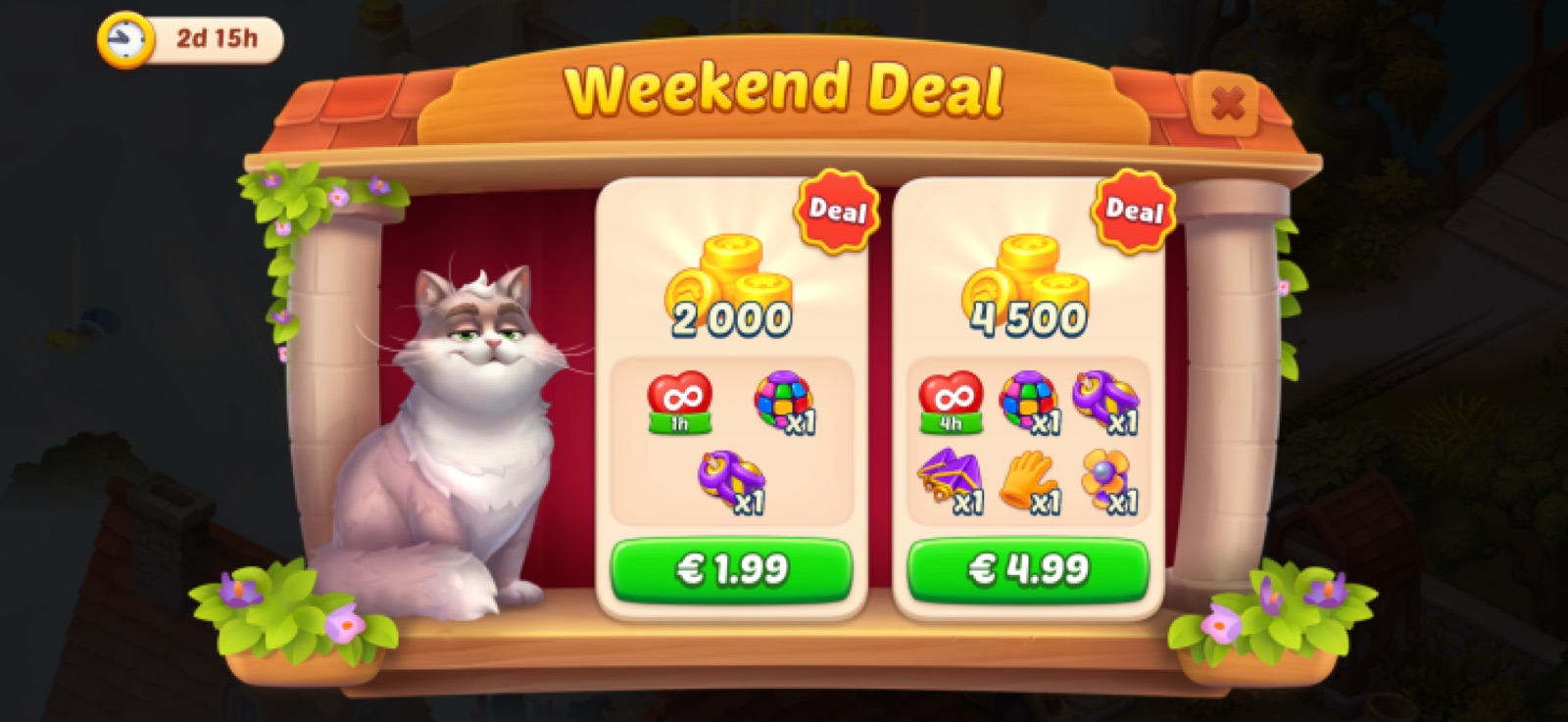
This is a structurally unique approach in the mini-shop:
- All other cards show price → player decides → taps to purchase
- Weekend Deal shows no price → player commits to opening → chooses between two options in popup
Timer: 2 days 15 hours — a longer urgency window than the 60-minute Special Offer, appropriate for a weekend-anchored offer.
Assessment of the no-price card design:
The hidden price is not a UX defect — it's a technical constraint. The Weekend Deal contains two bundles at different price points inside the popup, so there is no single price to display on the card face.
The real question is conversion cost: the "Get" CTA adds one tap to the funnel compared to direct-purchase cards. For a time-limited offer with a 2d+ timer this is an acceptable tradeoff — the urgency is soft enough that the extra click doesn't create meaningful drop-off. The two-tier popup is smart audience segmentation: price-sensitive players take the lower bundle, high-spenders take the upper one, within a single surface and a single offer slot in the carousel.
7. Social Proof Badges
| Offer | Badge | Justified? |
|---|---|---|
| Monopolist's Kit | Best value | — highest content efficiency in kit lineup |
| Steward's Kit | Most popular | — mid-range kit, likely highest conversion volume |
| Pack 6 (100K coins) | Best value | — genuinely best coins/€ in permanent pack lineup |
| Pack 3 (10K coins) | Hit! | ⚠ — weakest step-up efficiency in the pack ladder (+6.6% vs Pack 2) |
| Hot Offer | Deal | — competitive value in its price slot |
| Welcome Pack | Deal | — solid entry-point value |
| Special Offer | Deal | — genuinely best coins/€ in mini-shop, backed by timer |
| Weekend Deal | Deal | — two-bundle popup requires no price on card; "Get" CTA is correct |
8. Overall Design Assessment
8.1 What's Done Well
- Mini/full shop split with "More Offers!" gate — effective intent-filtering
- Seasonal content (Home Pass, Weekend Deal) injected into mini-shop anchor slots — correct priority
- Special Offer is both the most urgent AND the best value — proper alignment of mechanics
- Currency pack ladder is monotonically increasing — no pricing paradoxes
- Top pack (100K) delivers a genuine 2× bonus — strong whale reward
- Social proof badges placed on the right tiers
- "Activate" CTA on Home Pass — smart purchase framing
- Two-tier booster distribution (full vs. partial set) — consistent, deliberate economy design
- Weekend Deal two-bundle popup — smart segment splitting
- Post-purchase sort inversion (ascending → descending by price) — contextual shop adaptation based on spender state
8.2 Problems
| Problem | Severity | Book Chapter |
|---|---|---|
| Intro offer (€0.99) has no "One Time Only" marker — no urgency, no scarcity signal | Critical Critical | Ch 7: Pop-up Shops + Ch 13: Payment UX |
| Starter Kit (€4.99) has worst coins/€ in mini-shop with no compensating mechanic | High High | Ch 2.2: Bundle Design Patterns |
| Kit scaling is 1:1 across four tiers — no content premium for upgrading | High High | Ch 2.2: Bundle Design Patterns |
| Booster cost per unit flat or rising from Butler's to Family | High High | Ch 10: Pricing Psychology & Anchoring |
| Pack 2 → Pack 3 step is only +6.6% efficiency — dead zone on the ladder | Medium Medium | Ch 11: Currencies & Economy Fit |
| "Hit!" badge on Pack 3 (weakest efficiency step in the ladder) | Medium Medium | Ch 3: Working on Conversion |
| Shop named "Bank" — anti-spending mental model | Low Low | Ch 1.2: Layout |
| No free daily gift / free reward section | Medium Medium | Ch 1.3: Sections |
9. Recommendations
9.1 Add One-Time Marker to the Intro Offer
The €0.99 intro pack needs an explicit "First Purchase Only" or "One Time Only" label, ideally paired with a 24h timer from first shop open. Without it:
- Players delay and forget
- Players who buy and return expecting the offer lose trust when it's gone
9.2 Rebuild the Starter Kit
The €4.99 Starter Kit has the worst value in the mini-shop with no FOMO mechanics. Two options:
Option A — Make it a proper starter pack: Keep €4.99, add unlimited lives (1h), increase coins to 3,500, add "One Time Only" + 24h timer.
Option B — Replace with a rotating offer: Remove Starter Kit's permanent slot and replace with a daily rotating limited offer, creating a reason to check the mini-shop more frequently.
9.3 Introduce Content Premiums at Mid-to-High Kit Tiers
Break the 1:1 scaling pattern with a modest content premium:
| Kit | Current Coins | Recommended Coins | Rationale |
|---|---|---|---|
| Butler's | 5,000 | 5,000 | Base tier unchanged |
| Steward's | 10,000 | 11,000 | +10% content premium |
| Landlord's | 25,000 | 27,500 | Premium grows with tier |
| Family | 50,000 | 57,000 | Strong mid-to-high incentive |
| Monopolist's | 70,000 | 70,000 | "Best value" maintained |
9.4 Fix the Pack 2 → Pack 3 Dead Zone
Increase Pack 3 from 10,000 to 12,000 coins (keeping €14.99). This raises the step-up efficiency from +6.6% to ~+27.9% vs Pack 2, making the "Hit!" badge accurate.
Conclusion
Homescapes is a sophisticated monetization operation — and it shows. The mini/full shop split with the "More Offers!" gate is smart architecture. The currency pack ladder is clean and monotonic. The Special Offer with its 60-minute window is the best value in the carousel and genuinely earns its urgency mechanic. The post-purchase sort inversion is a subtle but well-executed contextual adaptation. The Weekend Deal two-bundle popup is intelligent audience segmentation. At this level of product, the good choices are clearly deliberate.
But several issues stand out precisely because they sit at odds with the overall quality. The intro offer at €0.99 — confirmed one-time, disappears after purchase — carries no scarcity signal whatsoever. A "One Time Only" label costs nothing to implement and would materially lift conversion on the most important first-purchase SKU in the shop. The Starter Kit at €4.99 has the worst value in the mini-shop carousel with no compensating mechanics: no timer, no badge, no exclusivity. It occupies a high-visibility slot without earning it. And across the four mid-tier Kits, the 1:1 price-to-content scaling leaves no financial reason to step up — the bundle ladder is present in structure but absent in incentive.
These aren't architectural problems. They are configuration-level fixes: add a label, adjust a coin count, introduce a modest content premium. For a product at Playrix's scale, each of these represents a meaningful revenue opportunity hiding in plain sight.
The frameworks behind this analysis — pricing psychology, bundle progression, shop structure, and conversion mechanics — are covered in depth in Game Shops — Ultimate Guidelines.
Get new teardowns by email
One email when a new shop teardown is out, usually twice a month. The numbers, what works, what I'd change. Unsubscribe in one click.
Game Shops: Ultimate Guidelines
300+ pages of shop frameworks, pricing math and real shop breakdowns. Everything behind the teardowns on this site.
Get the bookSample shop report
A real Game Shop Snapshot: the top 5 issues in a live game's shop, the numbers behind each one and the order to fix them in.
Download the sample
Michael Khripin has spent 25+ years in online games: LiveOps, monetization and production, including Wargaming R&D and LiveOps on Hero Wars Mobile at Nexters. Author of Game Shops: Ultimate Guidelines. Runs New Perk, a game shop and LiveOps consultancy.